

Regional value growth slows amid affordability constraints and elevated interest rates

Key takeaways
Regional property markets are experiencing a slowdown in value growth as affordability constraints, normalising listing levels, and the elevated interest rate environment continue to impact growth
Regional markets saw dwelling values increase by 1.3% over the three months to July, compared to a 1.8% rise in capital cities.
Queensland has emerged as the leader, overtaking Western Australia from the top spot for the quarter
In contrast, the report notes a decline in values across 14 regional New South Wales markets and six regional Victoria markets.
After accelerating through the first quarter of the year, rental growth across the combined regions is once again losing momentum.
Regional property markets are experiencing a slowdown in value growth as affordability constraints, normalising listing levels, and the elevated interest rate environment continue to impact growth, according to CoreLogic’s Regional Market Update.
Regional markets saw dwelling values increase by 1.3% over the three months to July, compared to a 1.8% rise in capital cities.
The pace of growth has eased from recent peaks as normalising internal migration patterns cool demand for regional housing.
The quarterly growth rate in regional dwelling values has slowed from a recent high of 2.2% in April to just 1.3% in July.
The capital cities have also seen a moderation in growth, albeit milder, from 2.0% to 1.8% over the same period.
However, that growth trends across Australia’s largest 50 non-capital city Significant Urban Areas (SUAs) have become increasingly diverse, with 40% of these regions recording a decline in values over the quarter, while 11 regions saw values rise by more than 3%.
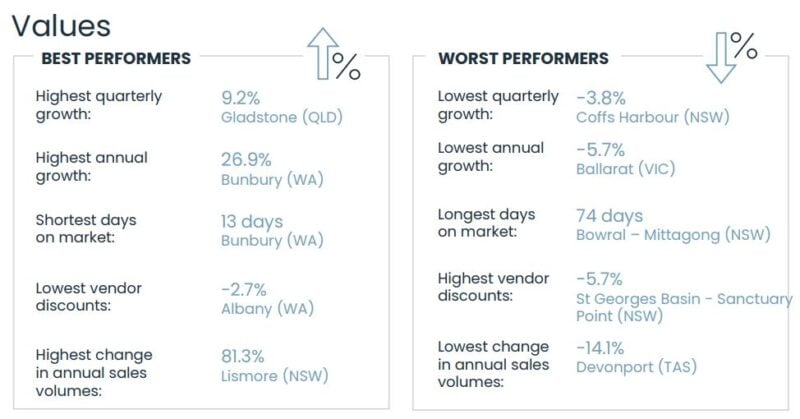
Over the three months to May, just eight markets recorded quarterly declines in values.
That number has since more than doubled, with 20 of the 50 largest SUAs now recording falls over the three months to July.
As the higher cost of listing and high interest rates environment continues to put pressure on households’ balance sheets, it’s likely we’ll continue to see values and rents moderate in the coming months.
Queensland takes the top spot, while markets in NSW and Victoria decline
Queensland has emerged as the leader, overtaking Western Australia from the top spot for the quarter – with Gladstone values rising 9.2% over the three months to July.
Other strong performers for the quarter include Townsville (7.8%) also in Queensland, along with Busselton (7.2%), Bunbury (6.7%), and Geraldton (6.2%) in Western Australia.
These regions also recorded annual growth exceeding 20%.
In contrast, the report notes a decline in values across 14 regional New South Wales markets and six regional Victoria markets.
Coffs Harbour (-3.8%), Ballarat (-3.4%), and Orange (-3.1%) saw the most significant declines over the quarter, although only five markets saw an annual decrease in values.
The recent declines seen across NSW and Victoria have seen some markets that had recently recovered value losses fall back below peak.
Dubbo and Wagga Wagga are now -3.6% and -2.9% below the recent January peaks, while the Albury -Wodonga, Mildura – Buronga and Tamworth regions are -1.0%, -0.7%, -0.3% below their April peaks.
Rental growth loses momentum
After accelerating through the first quarter of the year, rental growth across the combined regions is once again losing momentum.
The CoreLogic regional rental index recorded a 1.3% increase over the three months to July, down from the 2.8% rise seen in the March quarter.
In comparison, capital city rents rose 1.1% in July, down from 2.9% in April.
Across the largest 50 non-capital city markets, just six saw a decline in rental values over the quarter, while all markets recorded increases in rents over the year.
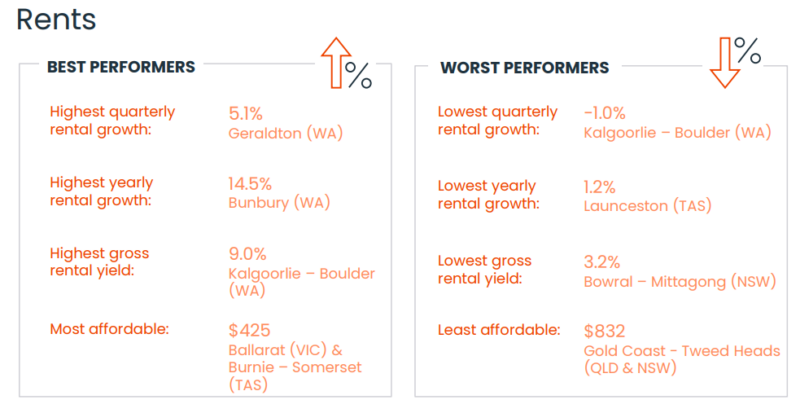
Geraldton in WA saw the strongest quarterly rent increase at 5.1%, followed by Traralgon – Morwell in Victoria (3.8%) and Victor Harbor – Goolwa in South Australia (3.6%).
The Kalgoorlie – Boulder region in WA experienced a -1.0% quarterly decline in rents, along with Forster–Tuncurry and Batemans Bay in NSW, and Launceston in Tasmania, while slight falls were seen in Bunbury and Ballarat.
Although the majority of markets are still recording positive rental growth, the pace of quarterly growth has eased in most regions, with many renters coming up against affordability constraints and some looking for ways to share the additional rental burden by forming larger households.
Despite Bunbury experiencing a negligible quarterly dip in rents, it recorded the strongest annual increase, with a 14.5% rise adding approximately $80 per week to the median weekly rental value.
Several other regions, including Geraldton, Albany, Busselton in WA, Gladstone, Bundaberg, Mackay in QLD, and Victor Harbor – Goolwa in SA, also saw double-digit rent increases over the year.
Launceston in Tasmania was at the other end of the spectrum, with rents rising just 1.2% over the 12 months to July, adding approximately $6 per week to the median weekly rental value.
Affordability concerns
Looking ahead, similar to the broader Australian market, affordability would remain a key challenge for regional Australia.
While growth in both values and rents is losing momentum, affordability continues to be a significant issue across the regions.
Dwelling values have risen by 52.5% since the onset of the pandemic, and rents are up 39.1%, compared to a 33.4% and 35.4% rise in the capitals.
