

The Price of a Big Mac Across the World [Infographic]
What can a Big Mac tell us about currency rates?
As it turns out, quite a lot.
The Big Mac Index, created by The Economist in 1986, started as a simple tool to make currency theory more digestible.
Now, it’s a widely-known measure in popular economics to assess and compare currency valuations.
In short, the Big Mac index compares the purchasing power parity (PPP) of currencies using the price of a Big Mac in the U.S. as the benchmark.
It shows how much a Big Mac costs in various countries compared to the U.S., but it also works as a way to assess exchange rates.
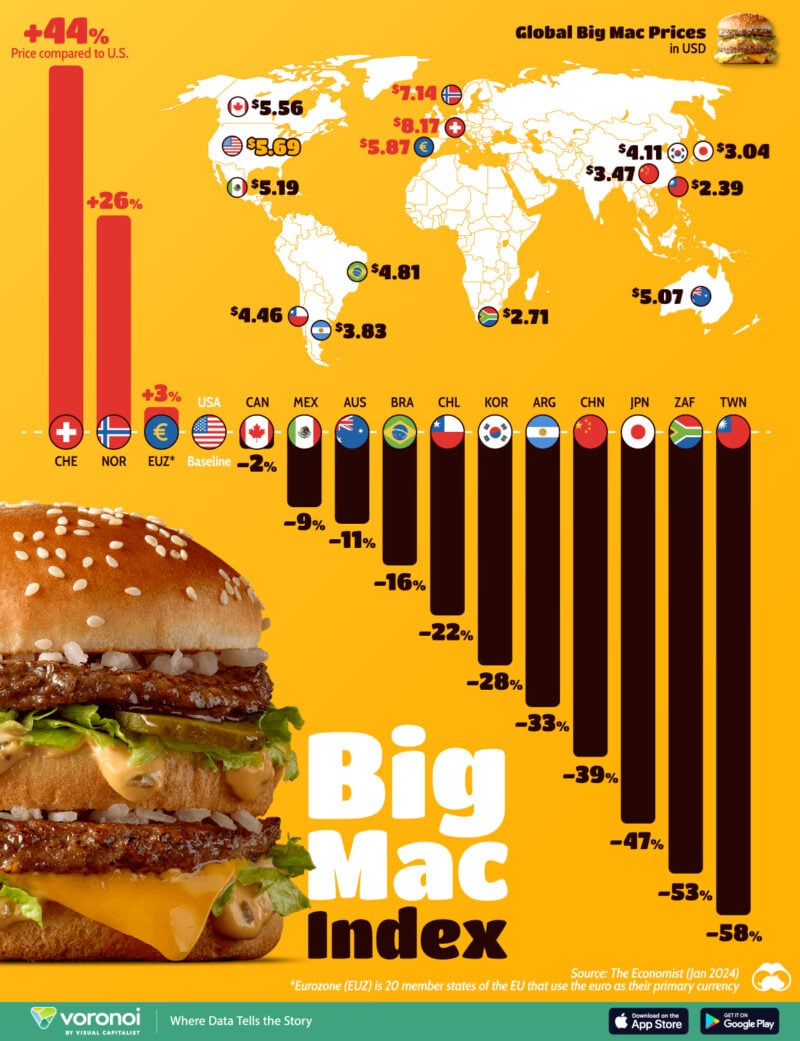
In this graphic, we visualize the price of a McDonald’s Big Mac in U.S. dollars between 13 different countries around the world, the eurozone, and the United States, using the latest January 2024 data from The Economist’s Big Mac Index dataset.
Calculating the Big Mac Index to Assess Currencies
One can use the price of Big Macs in other countries to see if a currency has more or less purchasing power than expected.
This is done by taking the local price of a Big Mac (in local currency) and dividing it by the U.S. price of a Big Mac to calculate an implied exchange rate.
This implied exchange rate is then compared against the actual exchange rate between the two currencies; if the implied rate is higher than the actual rate, the local currency is “overvalued”, and if it is lower, the local currency is “undervalued”.
It’s worth noting that this measure is relatively simplistic and doesn’t account for some factors like taxes, local production costs, and market barriers.
The Big Mac Index
Switzerland has the most expensive Big Macs in the world at $8.17 USD, which is 44% more expensive than the price of a Big Mac in the United States.
Using the Big Mac Index, that suggests that the Swiss franc is 44% overvalued against the U.S. dollar.
European countries like Switzerland, Norway, and those in the eurozone tend to have more expensive Big Macs than the United States.
This indicates that these European currencies may be overvalued relative to the U.S. dollar.
On the other end of the spectrum, several major East Asian economies, including Taiwan, Japan, China, and South Korea, have currencies substantially undervalued against the U.S. dollar, according to the Big Mac Index.
In April, the Bank of America stated it was not bullish “on any currency in Asia” and mentioned the Chinese yuan, South Korean won, and Taiwan dollar under its bearish category.
In June, the Japanese yen hit a 38-year low against the dollar.
Guest author is Kayla Zhu, a writer at The Visual Capitalist. You can read the original article here.