
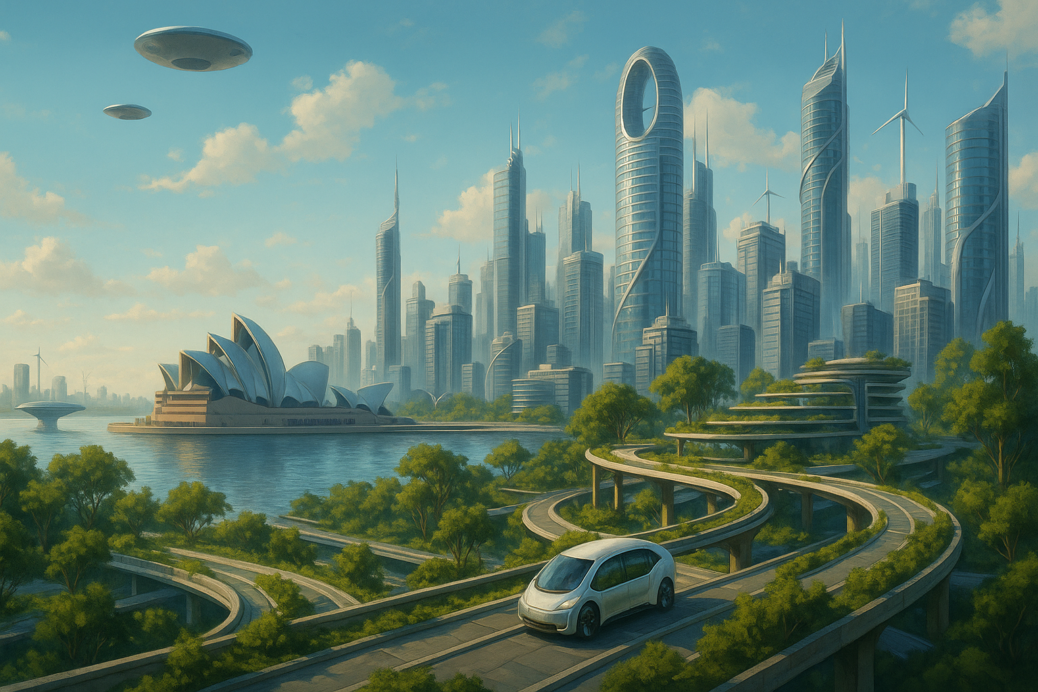
What Will Life Look Like in 100 Years?
Key takeaways
Australia has transformed beyond recognition in the last 100 years.
The next 100 will be even more dramatic.
The key message: We are already building the future through today’s choices.
From housing and healthcare to migration and technology, the seeds we plant now will determine the shape of 2125.
A century ago, Australians were still recovering from World War I.
There was no television, no supermarkets, and no suburbs as we know them today.
People lived closer to the city because that’s where all the jobs were.
Most women stayed at home, the average household had several children, and migration was largely from the British Isles.
Now, rather than looking back a century, fast-forward 100 years.
Can we even begin to grasp what Australia might look like in 2125?
While it’s tempting to say the future is unknowable, in reality, many of the foundations of tomorrow are being laid today.
In a recent episode of Demographics Decoded, Simon Kuestenmacher and I unpacked what life could look like in 100 years, drawing on demographic and social trends, housing patterns, and historical context to paint a picture of Australia’s potential future.
Here’s what we uncovered.
For weekly insights and strategic advice, subscribe to the Demographics Decoded podcast, where we will continue to explore these trends and their implications in greater detail.
Subscribe now on your favourite Podcast player:
The shape of our cities: still familiar, just denser
If someone from 1925 looked at a map of Australia today, they’d instantly recognise the major cities: Sydney, Melbourne, Brisbane, Adelaide, Perth.
What might surprise them is that despite a fivefold population increase, we haven’t really created any new major cities, except for the Gold Coast.
Simon pointed this out perfectly: “If the time traveller from 1925 arrived in 2025, they’d feel very familiar with the map. That in itself is quite spectacular, we added people but not new cities.”
So, what does this mean for 2125?
We’re likely to see existing cities expand rather than entirely new urban centers emerge.
Building a new city requires immense political will, planning, and infrastructure investment, and right now, there’s little appetite for that.
Unless that changes, we’ll continue to funnel millions more people into the same cities, stretching infrastructure, public transport, and housing supply.
The Gold Coast offers a rare case study.
Once a retirement destination dubbed “God’s waiting room,” it’s now evolving into a self-sustaining economic and cultural hub, a proper city in its own right.
“It’s a success story,” Simon noted. “It might not be for everyone, but it added choice to our urban landscape.”
In the next century, we’ll need two or three more ‘Gold Coasts’.
Smaller families, longer lives, and a shift in the social fabric
Family life has changed over the last century, and that’s only going to accelerate.
Fertility rates continue to fall, with many Australians choosing to have fewer children, or none at all.
Back in the 1920s, large families were the norm. Today, a two-child household is the average.
In 2125, the norm may be one-child or even child-free families.
But there’s a twist.
Simon floated the possibility of a swing back. “If housing becomes more affordable and wealth is abundant, people might feel more optimistic and decide to have more kids again.”
In other words, it’s not just about culture, it’s about confidence.
Meanwhile, lifespans are expected to increase dramatically. With better healthcare and breakthroughs in biotechnology, living to 100 could be common by the end of the century.
But this brings a big challenge: how do we care for an ageing population?
By 2080, today’s millennials will be retirees.
And they’re a bigger cohort than the baby boomers.
Our aged care system, already under pressure, just won’t cope without a dramatic transformation.
“We’ll hit a crisis point in about 15 years when the number of 85+ Australians doubles,” Simon warned. “And that’s just the beginning.”
It raises tough questions.
Will euthanasia become a more accepted end-of-life option?
Will we work into our 80s?
What role will families play in caring for each other as geographic mobility increases and fewer adult children live near ageing parents?
We’ll need new systems, such as community-based care, smart homes that support independence, and perhaps even AI-assisted eldercare, to help people live healthier, longer, and with dignity.
The future of work: knowledge-based, tech-driven
In 1925, most people worked in agriculture, factories, or trades.
Today, it is services, finance, health, and technology.
Fast forward to 2125 and you can expect the knowledge economy to dominate even more.
In fact most people will have jobs we can’t even imagine yet, but they’ll be intellectual in nature.
With AI and automation likely to replace many routine and physical tasks, human value will increasingly lie in creative thinking, empathy, leadership, and effective decision-making.
This could support a continued shift toward remote work, reducing the need to cluster near city centres.
Our cities might become polycentric, clusters of work and lifestyle hubs dotted throughout the suburbs.
And yes, we’ll probably work longer – with life expectancy approaching 100, the idea of retiring at 65 will seem quaint.
“We can’t have people retired for 35 years while only working 35 years,” Simon pointed out. The maths simply doesn’t work. “
Expect retirement to be phased, flexible, and optional.
Housing: smart, smaller, and built to last
Think about how homes have changed over the last century: from outhouses and iceboxes to double garages, ducted aircon, and media rooms.
Homes in 2125 will look different again. Given land constraints and higher construction costs, homes are likely to become smaller, smarter, and more energy efficient.
Expect modular construction, solar integration, and universal design for aging in place.
But even if population growth slows later this century, the number of dwellings we need will keep rising because of smaller households.
If the average household size drops from 2.5 to 2.0 over the next 100 years, and we double our population, we’ll need far more housing than we do today.
That means greater demand, denser developments, and likely a rethinking of suburban sprawl.
Migration & multiculturalism: our greatest social asset
Back in 1925, Australia was largely white, Anglo-Celtic, and Christian.
Today, we are one of the most multicultural nations on Earth.
Migration has shaped our economic and social resilience.
Roughly two-thirds of our population growth now comes from immigration. And that’s not expected to change.
“Australia is a grand national experiment in multiculturalism,” said Simon. “And so far, it’s been a success.”
By 2125, we’ll likely be even more diverse and hopefully, even better at inclusion.
But that requires effort.
It means making sure all Australians feel connected to their communities, can participate fully in the economy, and feel a sense of shared purpose.
Technology: a blessing, a challenge, and an accelerant
From smartphones to AI, technology is evolving faster than any of us can keep up with.
The next 100 years will bring changes we can barely imagine today.
As Simon noted, “Innovation always comes first, regulation catches up later.”
The real challenge won’t be creating new technology; it’ll be shaping it ethically and responsibly.
Think of the current debates around social media, data privacy, and AI regulation.
Now imagine them supercharged.
But if we get it right, technology could solve many of the problems we’re worried about today, from aged care and loneliness to infrastructure planning and productivity.
Values: spirituality, meaning & human connection
Interestingly, while Australia has become more secular, Simon believes religion or spirituality might make a comeback, not necessarily in traditional forms, but as a search for meaning.
“Just because something didn’t happen doesn’t mean it isn’t true,” he said, referencing how religious stories might be viewed as metaphors, not literal events.
As people search for purpose in a fast-changing, often chaotic world, these traditions could offer a sense of grounding.
We’ll need that, especially as AI, climate change, and geopolitical volatility make the world feel less certain.
Connection, whether through faith, family, community or technology, will matter more than ever.
Final thoughts: we shape the future today
It’s easy to look ahead and feel overwhelmed.
But remember, the Australia of today was once unimaginable too.
Back then, indoor toilets were a luxury. Women weren’t in the workforce. Suburbs didn’t exist.
There were no supermarkets, no Gold Coast, no multiculturalism.
Now look how far we’ve come.
As Simon reflected, “The real gift we could give the Australians of 2125 is a snapshot of how we feel today: our optimism, our fears, our hopes. Then they can ask: Were we right?”
The future isn’t fixed.
It’s built by the values we choose to champion, the policies we implement, and the communities we create.
And for property investors, business leaders, policymakers and everyday Australians, now is the time to think long-term.
Because the decisions we make today will echo across the next 100 years.
If you found this discussion helpful, don’t forget to subscribe to our podcast and share it with others who might benefit.
Subscribe now on your favourite Podcast player: